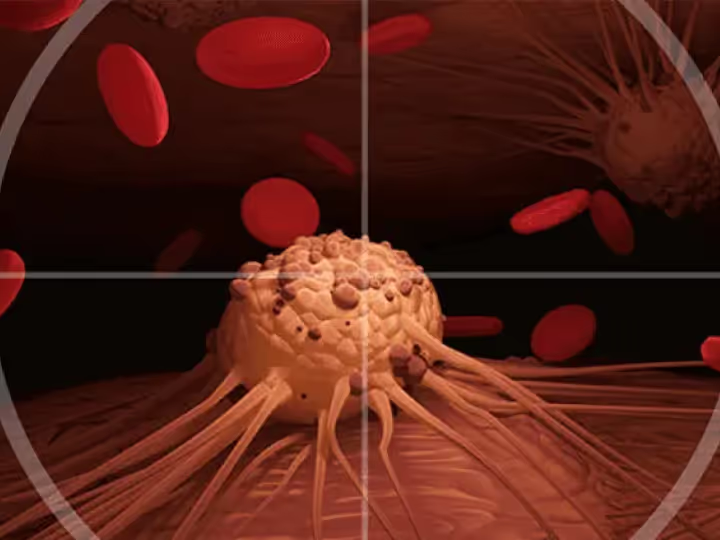
Chapter 3: Tissue Biopsy vs. Liquid Biopsy – Which Is Right for Me?

Chapter 3: Tissue Biopsy vs. Liquid Biopsy – Which Is Right for Me?
Understanding how doctors gather the genetic information needed to personalize your cancer treatment.
When your doctor recommends genomic testing, the goal is to study the DNA of your cancer to understand what is driving it. This requires a sample that contains cancer-specific genetic material. That sample can come from:
- A tissue biopsy: A small portion of the tumor collected earlier and stored as an FFPE block.
- A liquid biopsy: A blood sample that captures cancer DNA circulating in your bloodstream.
Both are valid, powerful methods—and each gives doctors slightly different types of information. This chapter helps you understand these options in a simple, patient-friendly way.
What Is a Tissue Biopsy for Genomic Testing?
When you were first diagnosed, a biopsy was often done to take a small piece of the tumor. That tissue sample is preserved as an FFPE block, which can later be used for genomic testing.
For molecular profiling, a tissue biopsy gives:
A direct look at the DNA of the tumor itself—right from the cancer site. This helps doctors identify:
- Important gene mutations
- Biomarkers that guide targeted therapies
- Alterations that may not be easily detectable in blood
- A strong “baseline” understanding of your cancer’s biology at diagnosis
When is a tissue sample helpful for genomic profiling?
- When it was collected recently
- When enough tumor content is available
- When a deep, comprehensive genomic view is needed
- When ctDNA levels in blood may be too low
Summary: Tissue biopsy is often a foundational starting point for understanding your cancer at a molecular level.
What Is a Liquid Biopsy?
A liquid biopsy analyzes circulating tumor DNA (ctDNA)—tiny fragments of tumor DNA that the cancer releases into your bloodstream. This is a simple blood test, but extremely powerful.
Think of it as: Listening to what the cancer is doing right now, without needing to touch the tumor itself.
Liquid biopsy captures:
- New mutations that develop during treatment
- Changes in tumor behavior
- Genetic signals from multiple tumor sites throughout the body
When is liquid biopsy helpful?
- When a new tissue biopsy is not possible or is risky
- When the original tissue sample is too old (usually >6–12 months)
- When cancer has progressed or returned
- When doctors expect new resistance mutations
- When tumors are in difficult-to-reach locations
- When ongoing monitoring is needed during treatment
Summary: Liquid biopsy provides a fast, non-invasive way to stay updated on your tumor’s evolution.
Why Tissue and Liquid Biopsy Sometimes Show Different Results
Cancer is not static—it evolves.
- Mutations present at diagnosis may disappear after treatment.
- New resistance mutations may emerge.
- Metastatic tumors may behave differently from the original site.
What it reflects :-
- How your tumor looked at one moment in time.
- How your tumor looks right now.
The Power of Using Both Tests Together
Neither tissue nor liquid biopsy captures every mutation on its own. But together, they can dramatically increase the chance of finding important biomarkers.
Using both gives:
- A deeper genomic foundation from tissue
- A real-time update from liquid biopsy
- Higher likelihood of detecting actionable mutations
- A fuller picture when the cancer is complex or evolving
- More clarity for difficult treatment decisions
If feasible, many oncologists prefer a combined approach because it reduces the risk of missing information that could change your treatment.
When Doctors Often Recommend Doing Both Tests
- When the tissue biopsy is old: Cancer may evolve significantly after 6 months.
- When the FFPE block has insufficient tumor: Some samples don’t have enough tumor cells for full profiling.
- When you have multiple tumor sites or multiple primaries: Different tumors may carry different mutations.
- Cancer of Unknown Primary (CUP): Dual testing improves the chances of finding clues.
- When there is distant metastasis: Metastatic tumors may develop new mutations detectable in blood.
- When cancer returns or progresses during treatment: Liquid biopsy can detect new resistance mutations early.
- When another biopsy is too risky or not possible: Liquid biopsy becomes the safer alternative.
Strengths of Each Method (Simplified)
Tissue Biopsy (for Genomic Profiling)
- Direct molecular profiling from the tumor site
- Provides a detailed baseline snapshot of the cancer’s DNA
- Helps detect a broad range of genomic alterations
- Useful when the tumor is not shedding enough DNA into blood
- Often the foundation for the first treatment decision
Liquid Biopsy (Blood-Based Testing)
- Non-invasive and easy to repeat
- Reflects the tumor’s current genetic state
- Detects new mutations as the cancer evolves
- Useful when tissue is old, insufficient, or inaccessible
- Helps monitor treatment response and resistance
Which One Should You Choose?
There is no universal answer. Your doctor considers:
- The age and quality of the tissue sample
- How your cancer has behaved so far
- Whether your disease has spread
- Your overall health
- Whether treatment may have changed the tumor
- Whether repeated sampling is needed
A Final Thought: Trust Your Oncologist’s Guidance
Think of tissue and liquid biopsies as two viewpoints of the same story:
- Tissue biopsy shows the original chapter from the tumor site.
- Liquid biopsy shows the latest chapter from your bloodstream.
Together, they help your care team make informed, personalized decisions. Your oncologist considers clinical factors, safety, medical history, and cost before recommending the best path forward for you.